What Happens to Trees in the Four Seasons
DECIDUOUS Copse THROUGH THE SEASONS
Walking through a deciduous forest is a startlingly different feel from one time of the twelvemonth to some other. The trees leafage out in the jump, form a dense canopy during the summer, release their leaves to fall to the basis in the autumn, stand naked during the common cold of winter, and leaf out once once more when the side by side spring comes.
Today in Nature's Depths we look at these seasonal transformations a fiddling more than advisedly. Let's beginning in the spring, though we volition shortly run across that any particular starting signal is arbitrary.
The leap blush of the trees is delicate, with colors ranging from yellowish-green to pinkish depending on the proportion of the chief pigments— chlorophylls, carotenes, and anthocyanins—in the cells of their buds and emerging leaves. These are the aforementioned pigments we take encountered before in the context of photosynthesis and fall coloration.
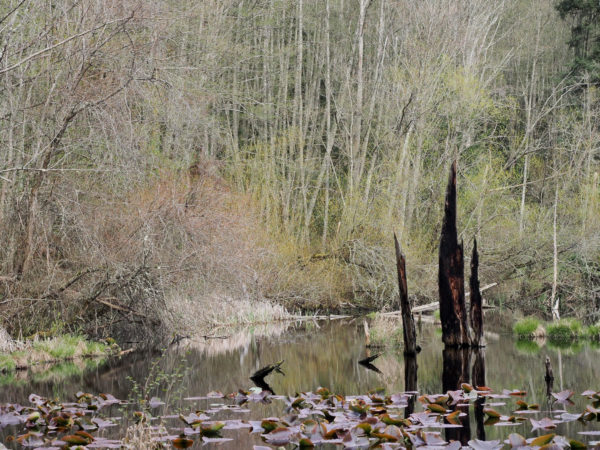
Leap in the wetlands of the Earth Sanctuary on Whidbey Island, WA.
In the summer, the woods surround usa with an intense dark-green. The leaves are using their chlorophyll to capture photons of light as efficiently as they tin can, and this free energy they then use to make the carbohydrate that powers metabolism and for the associates of the myriad molecules needed to create the structures of new life. This is photosynthesis, the procedure that straight or indirectly drives almost of life on World.
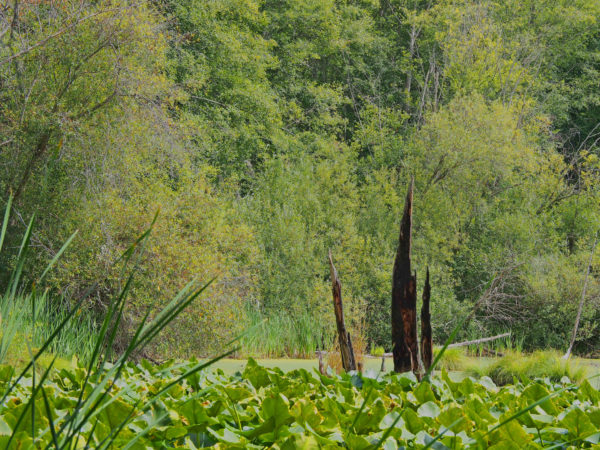
Summer in the wetlands of the Earth Sanctuary on Whidbey Island, WA.
In the fall another large shift starts to happen. Ane by one, and then in accelerating numbers, the green leaves lose their chlorophyll and thus stop photosynthesizing. This loss of green oft reveals the presence of the other pigments—the ruddy anthocyanins and orange or xanthous carotenes—and gives the forest its glorious autumn foliage.
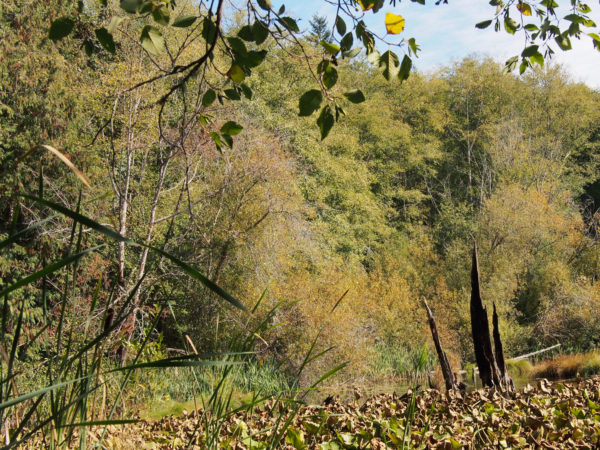
Early autumn in the wetlands of the World Sanctuary on Whidbey Island, WA.
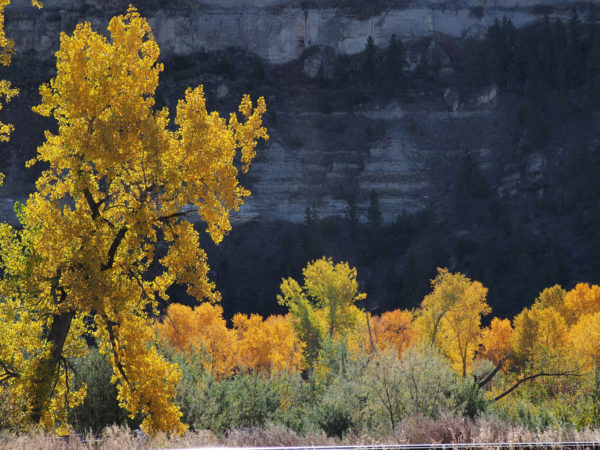
Autumn colors of cottonwoods (Populus deltoides) forth the Yellowstone River in primal Montana.
At some bespeak the copse release these no-longer-photosynthesizing leaves to fall to the ground.
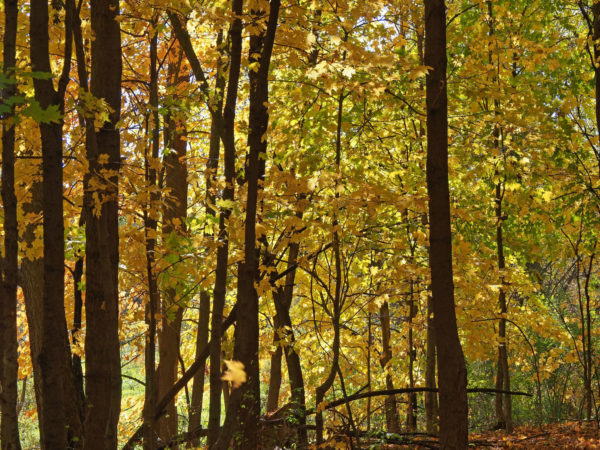
A single leaf of sugar maple (Acer saccharum) glowing against a dark trunk equally it falls. It looks larger and slightly out of focus considering it is closer than the tree trunks are.
In that location, the leaves accumulate to course a natural mulch that replenishes the soil.
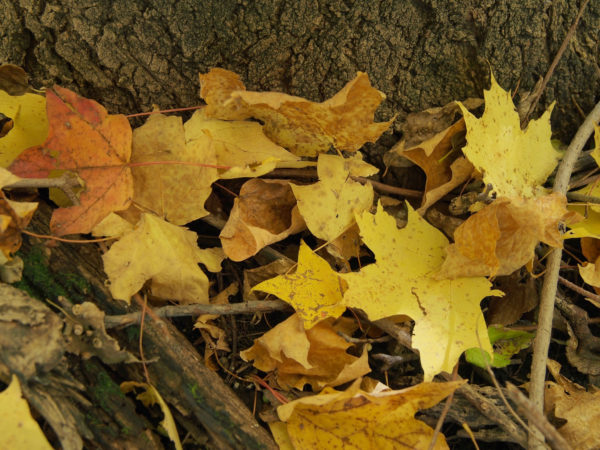
Fallen maple leaves accumulate confronting the trunk of a sugar maple.
During the winter well-nigh deciduous trees are naked of leaves and thus less susceptible to the water ice, snow, and wintertime winds that are capable of breaking limbs and snapping or uprooting whole trunks.
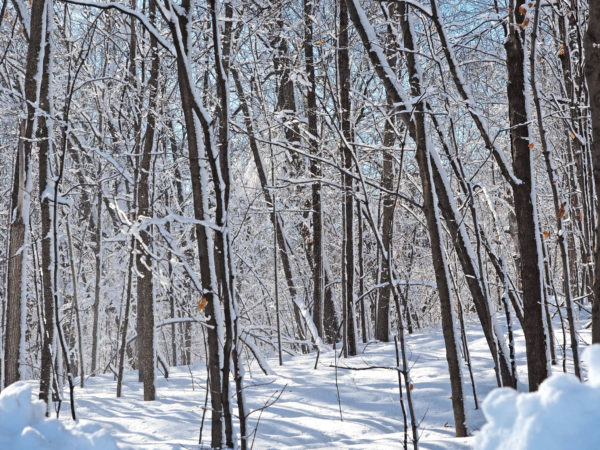
A deciduous forest in the Minnesota winter.
Some species, however, like this northern pin oak (Quercus ellipsoidalis), stay clad in leaves despite the extra weight, current of air resistance, and snow-communicable surfaces that the leaves provide.
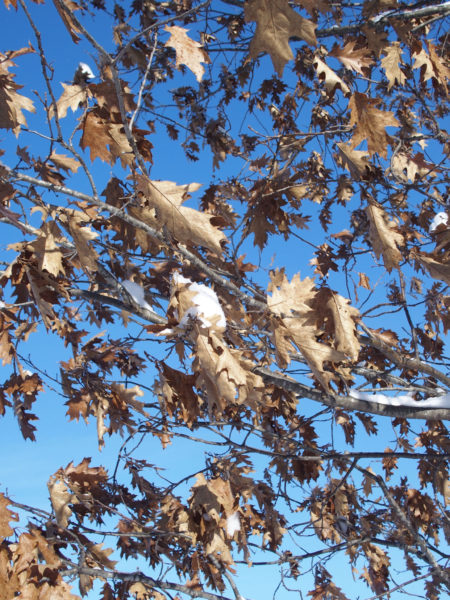
A northern pin oak (Acer ellipsoidalis) during the winter in Minnesota. Different most deciduous copse, this species keeps virtually of its dead leaves until leap.
PREPARATION FOR Leap RENEWAL
In the spring the wheel starts all over over again. The trees prepare for this well in advance. Even before the leaves autumn, buds from which the next yr'due south growth will outburst forth have been generated—non simply leaf buds merely also the rudiments of flowers, catkins, cones, and other reproductive structures.
Here is how the common red alders of the Pacific Northwest (Alnus rubra) gear up for the spring. If you look carefully in the angles (axils) between the branches and the leafage stalks (petioles), yous volition find in many a small-scale, elongated bud. These so-chosen axillary buds class well before the leaves turn colour and fall; they persist through the winter; and from them in the spring come the fresh stems and leaves of the trees' new growth.
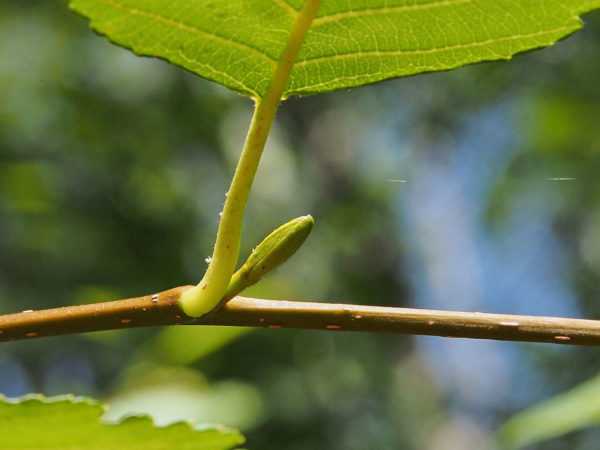
A branch of a red alder in Washington in the fall, showing the base of operations of a leaf that is nevertheless green (observe the design of veins), its petiole, and the associated axillary bud.
Looking further, particularly near the tips of the branches, you will also find male and female person flower buds developing in the autumn and ready to burst forth in the spring. The incipient male flowers are arranged in elongated catkins like these.
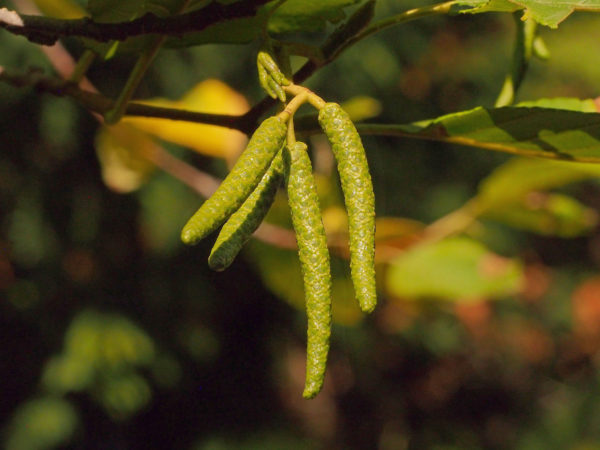
Four recently-formed male catkins of a red alder in early on autumn, simply as some of the leaves are falling.
The female flowers in the form of cones develop in the autumn, preparing to receive pollen in the bound. Hither they are glowing in the afternoon sun of September.
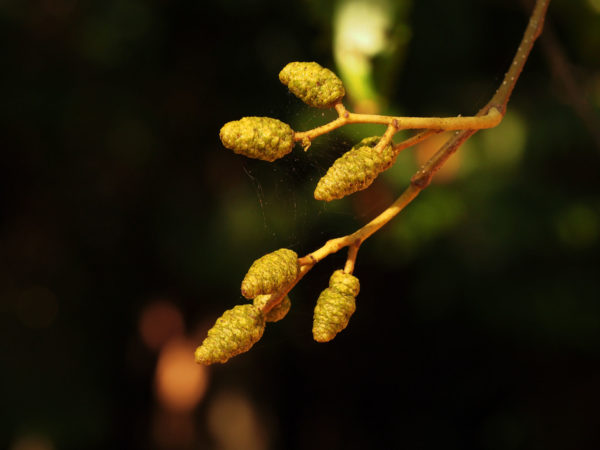
A cluster of young female person cones of a red alder in the fall, all set up to mature in the spring.
If you look at an alder advisedly, you may be able to encounter several generations of leaves, catkins and cones all at the same time—multiple phases of the ongoing cycle of life captured in a single view. In the movie below this year'south leaves have been shed, but there is a leaf bud at the top. And then, going clockwise, we see new male person catkins, last yr's female cones still remaining on the tree, and new female cones prepared for the jump.
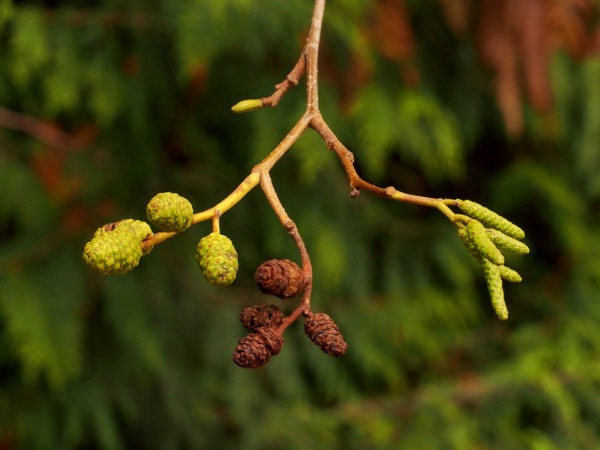
A red alder in the fall, with buds all set for the following bound and a cluster of female cones remaining from the previous spring.
LIFE GOES ON IN Winter
We often think of the wintertime every bit a time of dormancy for a deciduous tree, of a residuum from the frenetic processes of life. So it is. The leaves fall so in that location is no photosynthesis and thus no fresh carbohydrate to fuel metabolic processes. Just the tree's stored reserves, establish primarily in the roots, provide the energy for life. The temperature is cold. Life slows down. It does not stop, however. Individual cells keep to perform the biochemical reactions that constitute the living land, and the whole tree is poised to accept full advantage of the nourishing conditions of the next spring.
In the next post we will explore the mechanism by which a tree actively drops its leaves at the appropriate time. In the future we will ask how copse recognize what season it is, and past what processes their activities are regulated so that they will exist in harmony with both the prevailing season and with the season which is approaching.
Now I invite y'all to contemplate the annual cycle of a tree's life as you walk through the fall woods and revel in the most daily changes yous can meet and odour effectually you.
bushclontriled1958.blogspot.com
Source: https://naturesdepths.com/trees-through-the-seasons/
0 Response to "What Happens to Trees in the Four Seasons"
Post a Comment